In 1972, philosopher Peter Singer presented the world with a challenge as simple as it is uncompromising:
If it is in our power to prevent something bad from happening, without sacrificing anything of comparable moral importance, we ought to do it.
His core message is undeniable, if we have the ability to help someone in need, we have an absolute moral obligation to act. There is no valid excuse to turn away. We cannot hide behind the comfortable idea that helping others is just "charity," something optional or merely praiseworthy. You are not exempt because you didn't cause the problem, and you are certainly not exempt because thousands of other people could also act but haven't. If we can alleviate suffering without ruining ourselves, refusing to help is not just unfortunate; it is fundamentally wrong. You can read his essay in full here:
[Famine, Affluence, and Morality].
We strongly encourage every member of this fellowship to read it, as it powerfully frames our duty to one another.
To dismantle our remaining excuses, Singer targets the fiction we tell ourselves that physical proximity determines our moral duty. He argues that a child drowning right before our eyes carries the exact same moral claim on our help as a child dying of hunger a thousand miles away. The distance between us and the suffering changes absolutely nothing about our obligation to stop it.
We are not exempt from helping just because the suffering happens out of sight. Ignorance chosen deliberately is not innocence, and indifference to preventable harm is itself a kind of harm.
He pushes to what he calls the principle of marginal utility: we ought to give, and keep helping, until the point where doing so would cost us something as serious as what we are trying to prevent. This is a harder standard than almost anyone lives by, and Singer knew that. He was not writing to make us feel virtuous. He was writing to strip away our excuses, to make us feel the full, undeflected weight of our choices, and to ask whether we are brave enough to do what is right.
We draw equally from the work of Robin Wall Kimmerer: botanist, indigenous scholar, and author of [Braiding Sweetgrass] who reminds us that our obligations do not end at the boundaries of humanity. The Mother earth that built us, fed us, and will one day receive us back asks something of us in return. These two works, plus some other scriptures, form the moral bedrock of everything that follows in this Codex.
We, the Sodanitas, have read that argument, and we have taken it personally. Singer's charge was directed at an affluent world that had learned to look away. We choose, instead, to look directly. We accept that knowing creates responsibility. And we accept that responsibility freely.
This is not a document of perfection. It is a document of intentiom, a binding of ourselves, willingly, to a standard higher than comfort, and to a community that will hold us to it.
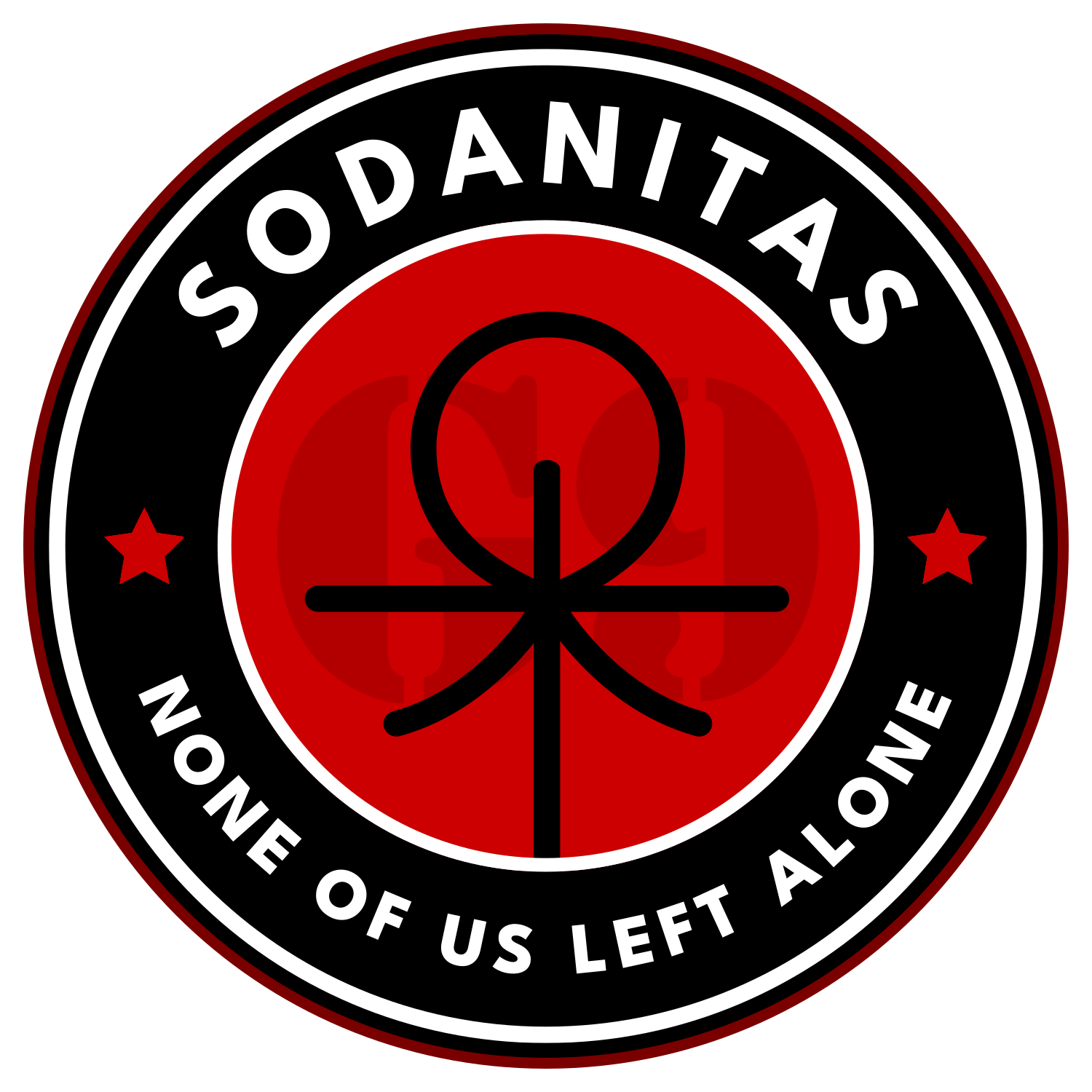
 Our symbol, the Vitakross, derives its name from: the Latin Vita (meaning life, or a noble way of living) and the ancient Germanic Kross (representing a structural cross or moral anchor) and is born from the union of two ancient and powerful icons: the Ankh and the traditional Christian cross, merged together with deliberate additions to create something entirely our own.
The Ankh, originating from ancient Egypt, is one of humanity's oldest symbols of life. By incorporating it, we acknowledge that life is not ours to waste or destroy, and that we must protect human existence with fierce devotion. The Christian cross grounds us in values that have guided people for millennia: humility, love, sacrifice, and grace. It calls us to love our neighbors as ourselves, to forgive as we wish to be forgiven, to show compassion to the vulnerable, and to live not for selfish gain but in service to others. Sometimes being nice is incredibly hard, but when you put goodness out into the world, it returns to you. We must treat others exactly how we want to be treated.
Together, this symbol is at once a declaration, a bond, and a personal promise. A declaration that we stand for life, respect, and human dignity. A bond: a sign to others that when they see it, they are in the presence of someone who genuinely cares. And a personal promise: a daily commitment to hold ourselves to a higher standard. We carry this symbol not as a mark of perfection, but as a constant, humble reminder of who we are striving to become.
A fellowship without direction is only a gathering. These four goals are where our virtues meet the world. They are broad on purpose, wide enough to hold a lifetime of work, and it is up to each member to find their own way of living them out.
We stand against anti-human groups. Movements that organize around the dehumanization of others, whether by race, religion, origin, or any other line drawn to separate "us" from "them," are a direct violation of everything the Vitakross stands for. We will not stay silent in their presence, and we will not treat their existence as someone else's problem to solve. We hold this position because we understand something they refuse to: had life dealt them different cards, they could easily be the very people they claim to hate. A different set of parents, a different town, a different circle of voices whispering in their ear growing up, and the hatred they carry now could just as easily have been pointed at themselves. None of us chose the family, the country, or the century we were born into. That is luck, not merit. So we extend understanding of how a person arrives at hatred, even as we refuse to excuse where they've let it take them.
We work to end suffering. Poverty that steals dignity before it steals anything else. Anger that has curdled into something that isolates rather than protects. The quiet devastation of sadness and depression that convinces someone the world would move on fine without them. Environments where a person cannot simply exist without fear, whether that fear comes from violence, from neglect, or from a system that was never built with them in mind. These are not separate problems to us. They are the same wound wearing different faces, and we treat them as such: with patience for the person, and without patience for the conditions that put them there.
We honour our debt to the natural world. The earth fed us, sheltered us, and will receive us back when we are done with this life. A debt like that is not settled by admiration from a distance. Animals are lliving things too, and so are plants. They are our neighbours. We act, in whatever way is within our means, so that what we were lent is handed forward intact, not liquidated for our own convenience. For some of us this means protecting land directly. For others it means changing what we buy, what we waste, what we speak up about, or what we teach the people coming up behind us. The scale of the effort matters less than the direction of it. What matters is that when it is our turn to hand the world to someone else, we are not ashamed of what we are handing them.
We return here to the debt we spoke of earlier: the earth fed us, sheltered us, and will receive us back when we are done with this life. A debt like that is not settled by admiration from a distance. It is settled by action, by treating the living world as Kimmerer describes it, not a warehouse of resources to be drawn down, but a community of relatives we are answerable to. The animals are not commodities. The forests are not inventory. The rivers are not waste disposal. They are neighbours, and neighbours are owed better than what convenience would have us give them.
We act, in whatever way is within our means, so that the living world we were lent is handed forward intact, not liquidated for our own convenience. For some of us this means protecting land directly. For others it means changing what we buy, what we waste, what we speak up about, or what we teach the people coming up behind us. The scale of the effort matters less than the direction of it. What matters is that when it is our turn to hand the world to someone else, we are not ashamed of what we are handing them.
We spread these ideas as far and as wide as we are able. A conviction kept private changes nothing. We speak, we write, we invite, we live visibly enough that others can see what this fellowship is and decide for themselves whether they want to stand beside us.
A shared purpose requires a shared direction. These ten virtues are the backbone of our community, helping us translate our values into everyday habits. They aren't meant to restrict you, but to support you in being a proactive participant in the world. Read them with an open mind, consider how they fit into your daily life, and return to them whenever you need a sense of grounding.
- [I]The Virtue of Clarity A member of the Sodanitas stands with unwavering integrity and speaks nothing but the truth. We do not deceive ourselves about the state of the world, and we do not deceive one another. Truth is the foundation on which all trust and therefore all bonds are built.
- [II]The Virtue of Agency A member does not idle away their days. We came into this world with hands, a mind, and a finite amount of time and all three are meant to be used. Laziness is not rest. Rest is sacred, deliberate, and earned. But to drift through your days without purpose, to leave your gifts unused and your obligations unmet, is a quiet betrayal of yourself, of your fellowship, and of a world that needs every capable person it can find. We are not innocent bystanders. We are participants. Participation requires effort. We work. We build. We create. We show up. Not because someone is watching, but because the person we are trying to become does not wait around for the right moment. They make it.
- [III]The Virtue of Aid A member helps wherever they can. We do not wait to see if others will act before we do. We do not wait to be asked. We do not calculate whether helping is convenient. We look for the need and we move toward it.
- [IV]The Virtue of Kinship A member regards every fellow member as kin. In a world that treats people as disposable resources, we make the counter-cultural choice: we are family. This is not sentiment alone. It is a practical commitment to show up physically, emotionally, financially when a brother or sister is in need.
- [V]The Virtue of Compassion A member is tender toward others and demanding of themselves. We do not project our standards onto those who are struggling: we reserve our rigour for our own conduct. Compassion is the recognition that everyone is fighting a battle we cannot fully see. We approach others with this knowledge, and ourselves with honest accountability.
- [VI]The Virtue of Nature A member loves nature, is kind to animals, and spares the growing things of the earth, not merely because these things are beautiful, but because we are in their debt in ways we cannot begin to repay. The moral circle is not drawn at the edge of humanity. It never was. It would mean to see the living world not as a storehouse of resources but as a community of beings, each one carrying its own purpose, its own right to exist. They are not objects. They are Neighbours. Relatives. Teachers, even, if we are willing to sit still long enough to learn.
- [VII]The Virtue of Respect A member respects leadership but questions it when needed. Blind obedience serves tyrants, reckless defiance destroys order. We honor wisdom where it exists and challenge power where it fails. True community demands neither servitude nor rebellion, but thoughtful engagement.
- [VIII]The Virtue of Temperance A member is cheerful and deliberate. We do not surrender to despair, nor do we act from panic. The demands of a moral life can feel overwhelming the need is vast, and we are finite. The answer is not paralysis. It is joyful, steady, considered action: taken daily, in proportion to what we can genuinely give.
- [IX]The Virtue of Sufficiency A member is frugal. We do not live in voluntary poverty, but neither do we live in careless excess while others go without. What we do not need, we give. What we have beyond sufficiency, we hold in trust for the world.
- [X]The Virtue of Wholeness A member is pure in body and in spirit. We tend to our physical health because a neglected body cannot serve. We tend to our inner life our motives, our resentments, our attachments because an unchecked spirit poisons everything it touches. Wholeness is not the absence of flaw, it is the ongoing, honest work of integration.
Before the Virtues can guide our actions, the Oath must bind our will. While rules provide an external framework, the Oath is a deeply personal commitment. It is the moment a member steps across the threshold from observer to participant, from sympathizer to kin.
I acknowledge that I was born into a world I did not build, onto an earth I do not own,
into a life made possible by forces older and greater than myself.
What I do with what I have been given, that is the only thing that is truly mine.
I swear to place the needs of others before my own comfort.
A suffering creature, whether it walks on two legs or four,
carries a claim on me that my convenience cannot cancel.
Selfishness is easy. I choose the harder thing.
I swear to speak the truth even when it costs me. To show up even when it is inconvenient.
To hold this community as family, and to leave the living world better than I found it,
because it will receive me back at the end, and I want to have been worthy of that.
I will not treat this oath as a burden, but as the shape of a life well lived.
And when I fail, as I will, I will rise, return, and try again.
On my honour, on the Vitakross,
and before those who stand beside me: I swear it.
A member of the Sodanitas is not required to be naive. Loving your neighbour does not mean pretending that your neighbour is incapable of harm. Extending compassion to all does not mean extending trust to all. There is a real and important difference between these things, and confusing them has broken more good people than we can count.
We are permitted, we are sometimes required, to feel righteous anger. At those who poison rivers for profit and call it progress. At those who exploit the weak and call it business. At those who have the means to help and choose, again and again and again, not to. Indifference to preventable harm is not a neutral position. It is a choice. It causes damage. We are allowed to name it as such, clearly and without apology, without dressing our anger up as anything more polite than what it is.
There are people in this world whose choices put them outside the warmth of this fellowship. Not because we have judged them beyond redemption, that is not ours to decide, but because they have, by their own repeated actions, shown us who they are. We do not owe unlimited patience to cruelty. We do not owe our vulnerability to those who have demonstrated they will exploit it. We are allowed to say, clearly and without cruelty: not here. not like this. not until something changes.
But here is where the line must be drawn, and drawn with care. Anger that names a wrong and holds a firm limit is righteous. Anger that becomes your entire identity is self-destruction wearing the costume of principle. The person who has given themselves over entirely to hatred has left no room inside themselves for the love that actually changes things. They have turned their wound into their worldview, and that is a prison, not a purpose.
We feel the anger honestly, we let it sharpen our limits and inform our loyalty, and then we turn our energy back toward nature, the people and the work. Hatred held long enough rots. Let it do its job, protect your boundary, protect those you love and then let it go.
The Sodanitas takes its name from ancient Latin fellowships: sodalities bound not by blood or geography, but by oath and shared purpose. We are not a religion, though we draw from the moral wells of many. We are not a political movement, though our values have inevitable political consequence. We are a community: particular, accountable, and alive.
Singer wrote that the way we live cannot survive moral scrutiny if we continue to treat the suffering of others as background noise to our comfort. He was right. But he offered diagnosis without medicine. The Sodanitas is the medicine: not a perfect cure, but a genuine attempt at collective healing. A structure in which the moral life is not a solitary burden but a shared practice. Where the oath is witnessed. Where failure is known and met with grace, not judgment. Where rising matters more than falling.
We believe that human beings are never a means to an end. We know we are far stronger together than we will ever be apart. And we know, because experience confirms it, that goodness put into the world returns. That when you treat others exactly as you wish to be treated, something opens. Something that looks, at last, like the life we were always meant to live.
If you believe that we owe each other care, that nature deserves our protection, and that a community built on real, living values is worth fighting for then this fellowship welcomes you. Come. Take the oath. Carry the Vitakross. Help us build something that family can rely on.
Message us at [ sodanitas@proton.me ]